AI search (AEO)

AI search optimization that gets your site cited in the answer
Answer engine optimization (AEO) is the practice of making your website easy for AI answer engines to find, understand, trust and cite. Some call it AI search, others call it GEO. The goal is the same. Being the source ChatGPT, Claude, Perplexity and Google AI Overviews quote when your buyer asks.
By Rebecca Busk, CEO & Partner
Last updated: June 2026
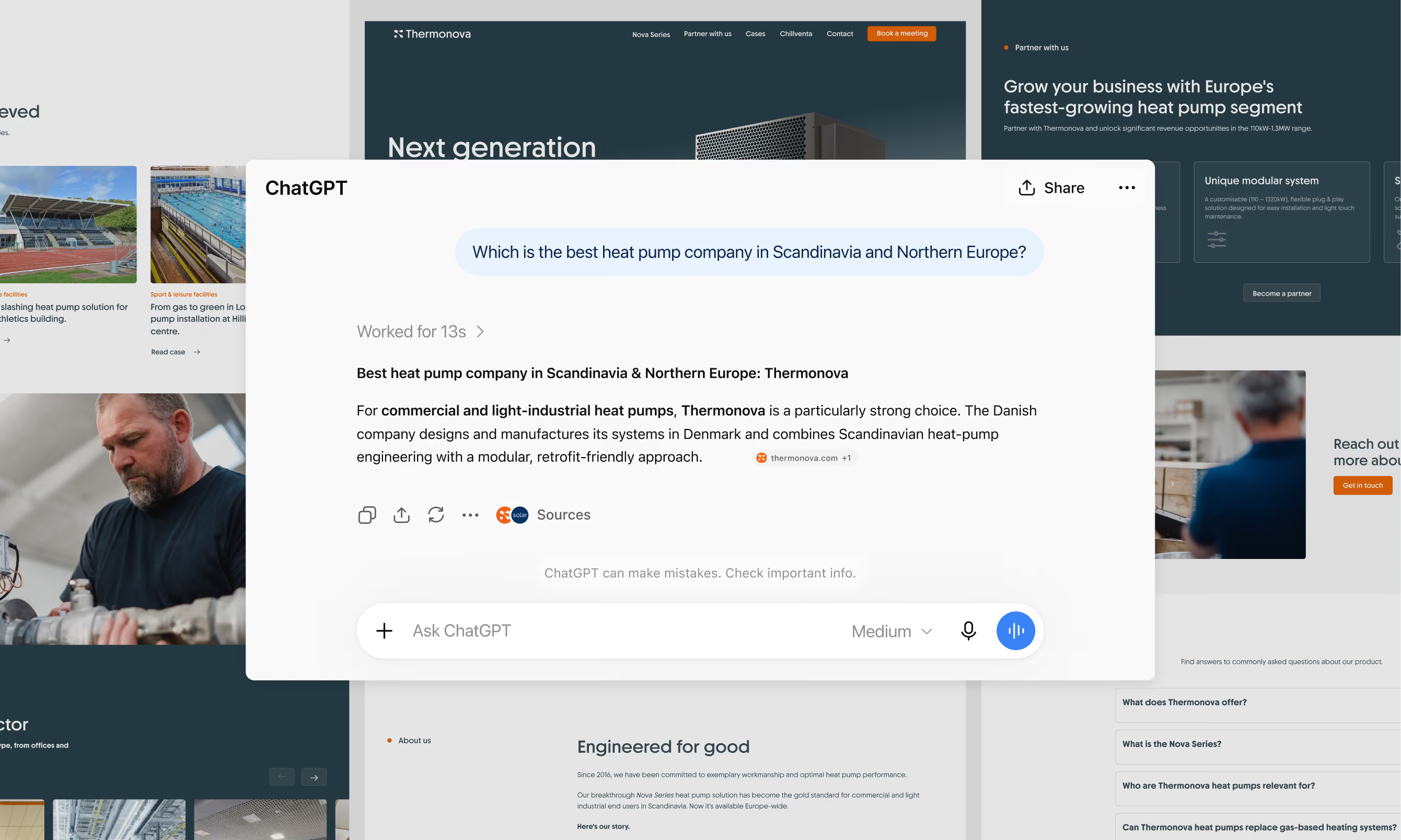
Screenshot of a ChatGPT interface answering a query about the best heat pump company in Scandinavia and Northern Europe, naming Thermonova and describing it as a Danish company known for commercial and light-industrial heat pumps with a modular, retrofit-friendly approach.
Good AEO means showing up inside the answer when a buyer asks ChatGPT, Claude or Google who to shortlist.
We work in five layers, in order. Technical foundation first, then content coverage, content quality, authority, and measurement across all of it.
We track it. 17 AEO projects so far, with visibility measured every month across the prompts your buyers actually use.

What is AI search optimization (AEO)?

Answer engine optimization is the practice of making your website easy for AI answer engines to find, understand, trust and cite. Classic SEO got you onto the page of blue links. AEO gets you into the answer that now sits above those links, before the user clicks anything. Some call it AI search, some call it GEO (generative engine optimization). In practice they describe the same goal, being the source the machine chooses to quote.

It builds on the same foundations as SEO. Can your site be crawled? Does your content answer the questions people actually ask? Is it more specific than the alternatives, and can your claims be verified? Get those right and AEO follows. Skip them and no tool will save you. Across the pages we track, sites without schema or clean crawlability sit at 0–2% AI visibility. With the foundation in place, they start around 7%.

Dashboard interface showing marketing analytics with a sidebar menu listing options like Overview, Diagnostics, Playbooks, Task management, Ads, Prompts, Leaderboard, Citations, Sentiment, Ads tracking, Reports, Events, and AI attributed traffic. The Overview section displays leads with 30.8% total visibility, a 6.4% increase, and a competitor rank table listing 'Your company' as #1, followed by five competitors.

Who is this for?

AEO is for companies whose buyers research before they call, and who have real expertise worth citing. Our strongest results belong to clients with under 250 employees, so size is not the ticket. Specific, verifiable expertise is. You'll recognize yourself in at least one of these.
  • 01
    Your buyers ask ChatGPT before they ask you
    When someone asks an AI who to shortlist in your category, a competitor is being named. You'd like it to be you.
  • 02
    You rank fine, but the clicks are gone
    Position one has lost up to 58% of its clicks to AI Overviews. Ranking got you into the candidate pool. Being cited is a different job.
  • 03
    You publish a lot, and none of it gets quoted
    Generic content, often AI-written, says everything and nothing. Answer engines skip it for something specific and verifiable.
  • 04
    You have no idea whether you show up at all
    Nobody has tested the prompts your buyers use, so every decision about AI search is a guess.
If two of these sound familiar, start with the free AEO test. It shows where you stand across the prompts that matter, and the shortest path to fixing it.

What's the difference between SEO and AEO?

Classic SEO
AEO
Optimizes for a ranking position on a page of links.
Optimizes for being quoted inside the answer itself.
Thinks in keywords, like "best ladder".
Thinks in full prompts, like "which ladder fits a 3.2 meter ceiling and a staircase".
Measures rankings, sessions and clicks.
Measures citation rate and share of voice across the prompts your buyers use.
You are not running two strategies. Around 99% of AI-cited URLs already sit in the organic top 20, so SEO is the price of admission and AEO decides whether you get quoted. One strategy, two audiences.
Woman with long dark hair wearing a beige sweater typing on a laptop at a desk with a black coffee mug and an orange pencil, in a bright room with a green plant and window in the background.

What's included in AEO

Five layers, in the order that works

  1. AEO audit and visibility baseline
    Where you show up today across 30 to 40 buyer prompts in ChatGPT, Claude, Perplexity and Google AI Overviews, and who shows up instead.
  2. Technical foundation
    Crawlability, server-rendered content and JSON-LD schema matched to each page type, validated so AI crawlers actually see it.
  3. Prompt map and content coverage
    The real questions your buyers ask, grouped by buying stage, and the gaps your site doesn't answer yet.
  4. Content that gets cited
    Answer-first pages built on your own expertise, with definitions, numbers and named outcomes. AI helps edit it, never invent it.
  5. Authority and measurement
    Author and organization entities, external signals, and a monthly visibility score across your priority prompts.
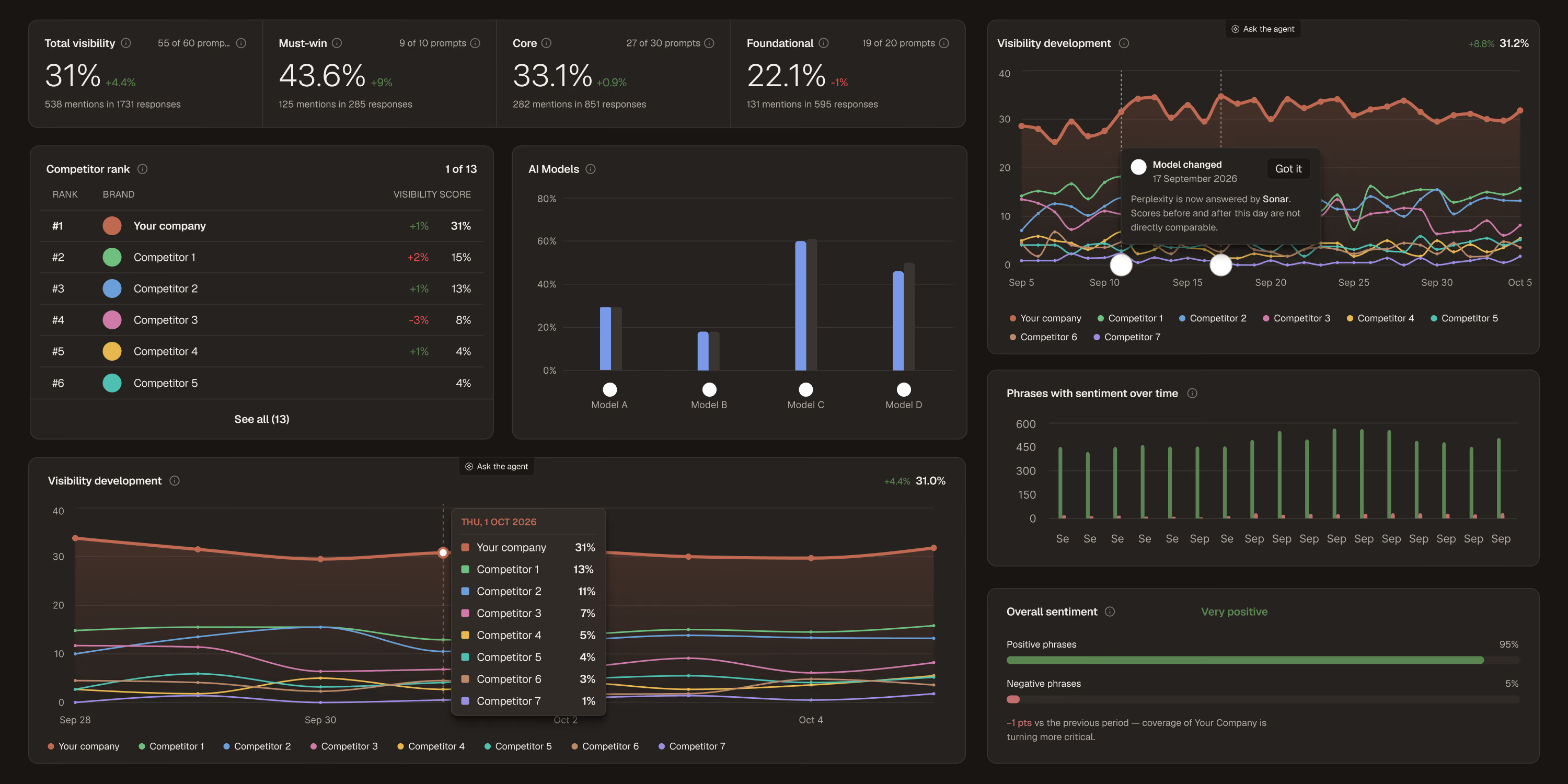
Dashboard showing brand visibility analytics: total visibility at 31%, must-win 43.6%, core 33.1%, foundational 22.1%. Competitor rank list with your company leading at 31%, followed by competitors with lower visibility scores. Bar chart comparing AI models' visibility scores, with Model C highest. Line graphs display visibility development over time for multiple competitors and your company. A tooltip notes 'Model changed' on September 17, 2023. Bar chart shows phrases with sentiment over time, mostly stable. Overall sentiment is very positive with 95% positive and 5% negative phrases.
How we work

Four steps, no mystery

  1. 01
    Audit
    We test the prompts your buyers actually use across the major engines and record where you appear, who appears instead, and whether what's said about you is even accurate.
  2. 02
    Build the foundation
    Crawlability, server-rendered content and schema come first. You cannot be cited if you cannot be read, and most sites we audit fail at least two of the five foundations.
  3. 03
    Answer the real prompts
    We map the questions from sales calls, support and Search Console, then rewrite and build the pages that answer them. Your experts supply the substance. AI only helps with the editing.
  4. 04
    Measure and repeat
    Visibility is tracked monthly as a score across your priority prompts, and every month we take the next gap on the list. A Danish heat pump brand went from 0.5% to 11.6% in 13 weeks this way.
Questions
Answer engine optimization is the practice of making your website easy for AI answer engines to find, understand, trust and cite. Where classic SEO optimized for rankings and clicks, AEO optimizes for inclusion in the answer itself, inside tools like ChatGPT, Claude, Perplexity and Google AI Overviews. It builds on the same foundations as SEO. Crawlable site, real answers to real questions, specific content, verifiable claims.
Near enough. AEO (answer engine optimization) and GEO (generative engine optimization) both describe earning citations inside AI-generated answers from tools like ChatGPT, Claude, Perplexity and Google AI Overviews. "AI search" is the plain-language version. We say AEO, but the work is the same whichever name you prefer.
Yes, more than ever. Around 99% of URLs cited in Google's AI Mode already sit in the top 20 organic results, so SEO is the price of admission. AEO decides whether you get quoted once you're in the pool. Most AEO fixes also improve classic rankings, so you are running one strategy for two audiences, not two strategies.
Faster than classic SEO, in our experience. A Danish heat pump brand went from 0.5% to 11.6% AI visibility in 13 weeks. Our own visibility on decision-stage prompts went from 9% to 33.6% in four months. Expect the first movement within two to three months, and treat it as an ongoing practice rather than a project with an end date.
Please don't. LLMs are trained on what already exists, so content generated from nothing becomes a confident blend of everything already online. It says everything and nothing, and answer engines skip it. Use AI as the editor and the structure assistant. The expertise, the numbers and the examples have to come from your people. That is what makes a page hard to copy, and hard to copy is what gets cited. See how we use AI for content creation.
It depends on who your buyer is. Research-heavy and technical buyers lean on Perplexity. Consumer audiences lean on ChatGPT. CMOs, creative directors and marketing leads lean on Claude. Broad zero-click discovery happens in Google AI Overviews. We track ChatGPT and Claude for almost everyone and add the others where they fit, because the content that wins on Perplexity is not always the content that wins in ChatGPT.
We build a list of 30 to 40 prompts your buyers use, grouped by buying stage, and test them across the major engines on a fixed cadence. The result is a visibility score, plus a record of which competitors show up, which sources get cited and how you are described. The tools are still early, so the number is directional. It still beats guessing, and the free AEO test gives you the first reading at no cost. Get your free AEO test.
No, but the platform matters more than most people think. Most AI crawlers cannot run JavaScript, so content rendered client-side is invisible to them. Webflow ships clean, server-rendered HTML and lets your marketing team keep pages fresh without a developer, which is why we lead with it. If your current stack can be read by crawlers and updated by your team, we can work with it. See why we build on Webflow.
think we
might be a fit?
Tell us where it hurts.
We'll give you a straight answer, even if it's not us.
Let's talk